AI Implementation Is At A Crossroads: Why Innovation Partnerships Will Beat Fixed-Cost Delivery
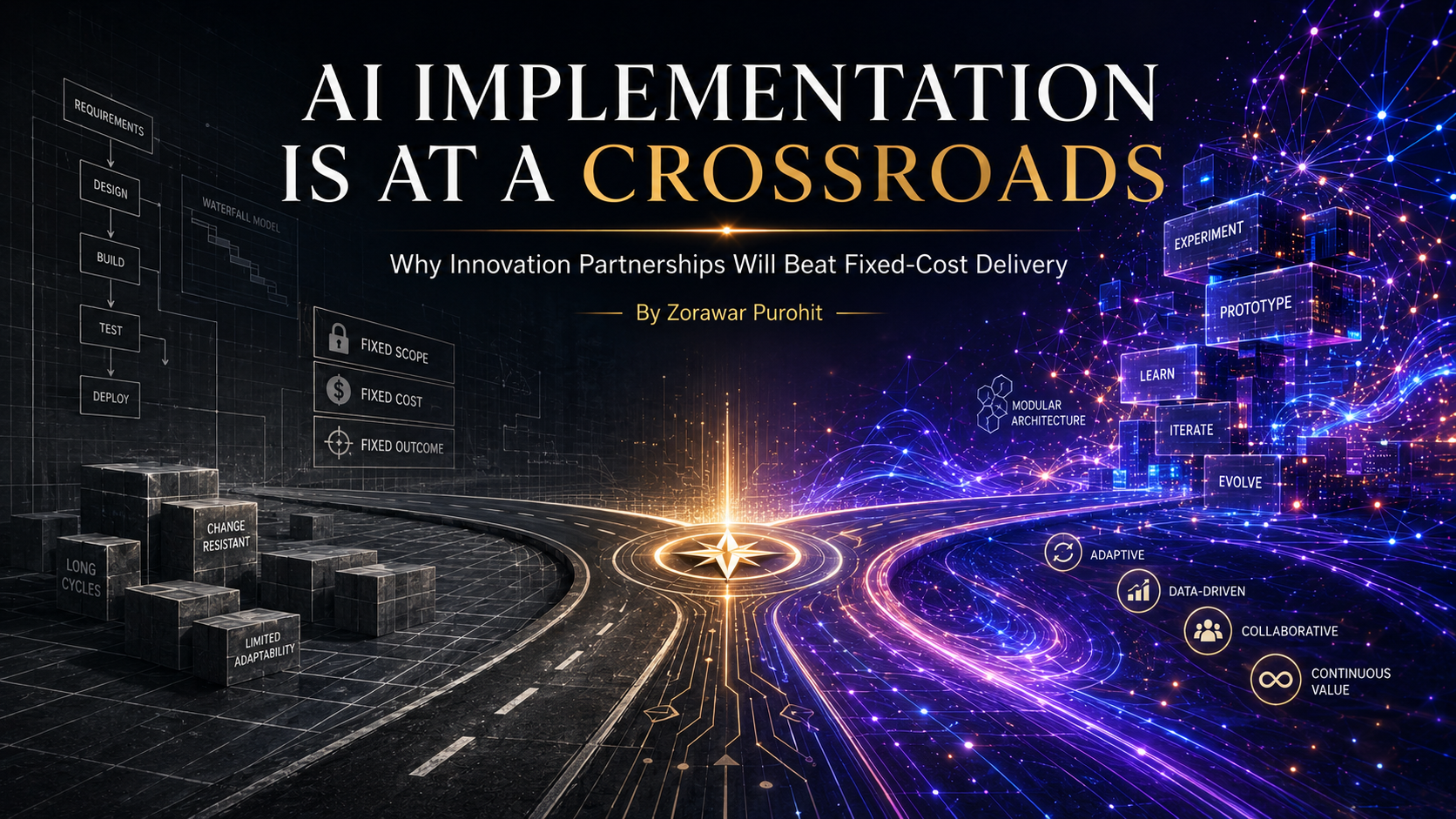
There is a very interesting tension emerging in enterprise AI today.
Almost every serious client conversation begins with the same familiar questions.
What is the delivery roadmap?
What will it cost?
How long will it take?
Can you share a fixed proposal?
These are fair questions. They come from years of software procurement muscle memory. For most of the last two decades, technology projects followed a reasonably predictable rhythm. A business problem was identified. Requirements were documented. A delivery partner scoped the solution. Timelines were estimated. A commercial proposal was signed. Engineering teams built the product.
That model worked because the destination was usually known.
The challenge with AI is that the destination is often not known yet.
In fact, discovering the destination is frequently the most valuable part of the engagement.
That is the crossroads we are standing at.
Enterprise clients want certainty. AI, by its very nature today, demands discovery.
The mistake is to force discovery into the shape of certainty too early.
The Old Software Model Is Not Enough For AI
Traditional software implementation was largely deterministic.
You knew the database. You knew the workflows. You knew the screens. You knew the user roles. You knew the business rules. You could estimate reasonably well how long it would take to build a dashboard, a CRM module, an approval flow, a document management system or an internal portal.
There was complexity, of course. There always is.
But most of the complexity was known complexity.
AI introduces unknown complexity.
A business may say, “We want an AI assistant for legal drafting.”
Sounds simple.
But what does that actually mean?
Should it retrieve from internal documents?
Should it reason over previous contracts?
Should it generate clauses?
Should it compare against templates?
Should it detect risk?
Should it explain why one clause is dangerous?
Should it work across jurisdictions?
Should it cite sources?
Should it remember user preferences?
Should it sit inside Word, Slack, Teams, a custom dashboard or an existing enterprise system?
Should the model be OpenAI, Anthropic, Gemini, Mistral, Llama, Qwen or a fine-tuned domain model?
Should the data live in a vector database, a graph database, a relational store, a hybrid retrieval layer or a custom search architecture?
Should the system use RAG, agents, workflows, tool calling, structured extraction, embeddings, reranking, fine-tuning or all of the above in the right places?
Suddenly the problem is not “build me a feature”.
The problem is “discover the architecture of intelligence that actually works for my business.”
That cannot be priced honestly like a brochure website.
Anyone who pretends otherwise is either oversimplifying the problem or preparing to hide the real cost later.
Most AI Use Cases Are Not Ready-Made SaaS Products
There is a strong illusion in the market that AI implementation is simply a matter of selecting the right SaaS tool.
Buy a subscription.
Connect the API.
Add your data.
Launch the assistant.
Celebrate the future.
Lovely story. Rarely true.
Most meaningful enterprise AI use cases sit at the intersection of messy data, business context, human behaviour, compliance pressure, legacy systems, domain expertise and model capability.
That is not a plug-and-play environment.
It is more like building a laboratory inside the enterprise.
The raw ingredients exist. The models exist. The cloud exists. The frameworks exist. The ambition exists.
But the activation has to be engineered.
This is where the real work begins.
You have to prototype. You have to test. You have to compare model behaviour. You have to evaluate latency. You have to study hallucination patterns. You have to understand cost per query. You have to measure retrieval quality. You have to decide where precision matters and where creativity matters. You have to know when to use a large frontier model and when a smaller open-source model will do the job better, cheaper and faster.
Sometimes the answer is a frontier model.
Sometimes the answer is an open-source model.
Sometimes the answer is a boring old classifier.
Sometimes the answer is better data hygiene.
Sometimes the answer is not an LLM at all.
That last one hurts the hype machine, but truth has never been a reliable marketing intern.
Fixed Cost Proposals Can Create The Wrong Incentives
The biggest issue with fixed-cost AI delivery is not commercial.
It is behavioural.
A fixed cost proposal forces both sides to pretend that the right solution is already known.
The client pretends the requirements are clear.
The vendor pretends the architecture is obvious.
The engineering team then gets locked into delivering what was sold, not necessarily what should be built.
That is dangerous.
In AI, early assumptions often collapse under testing.
A retrieval strategy that looked elegant in a slide deck may fail on real documents.
A model that performed beautifully in a demo may become too expensive at production scale.
A workflow that appeared magical in a controlled environment may break when exposed to real users, noisy inputs and edge cases.
A use case that seemed like a chatbot may turn out to need a multi-step orchestration engine.
A problem that looked like automation may actually require human-in-the-loop augmentation.
This is why fixed scope can become a technical trap.
It rewards early certainty when the work actually needs structured curiosity.
It encourages teams to deliver what was promised instead of discovering what is optimal.
That is how organisations end up with expensive AI systems that look impressive for three weeks and become abandoned furniture by the next quarter.
Polished demo. Weak spine.
We have seen this movie. It does not deserve a sequel.
AI Engineering Needs Intellectual Bandwidth
Good AI implementation is not merely coding.
It is not just prompt engineering.
It is not simply stitching together APIs and hoping the machine gods are in a generous mood.
It is engineering under uncertainty.
That requires intellectual bandwidth.
AI teams need the space to think deeply. To test multiple approaches. To throw focused light on the billions and trillions of parameters underneath these systems and understand the nuances that matter in context.
Which model understands the domain best?
Which model follows instructions reliably?
Which model handles long context without losing the plot?
Which model gives the best answer per rupee spent?
Which embedding strategy retrieves the right information?
Which reranker improves accuracy?
Which prompts are brittle?
Which outputs need guardrails?
Which parts need deterministic code instead of probabilistic reasoning?
Which architecture will survive scale?
Which design will still make sense twelve months from now?
These questions cannot be answered through guesswork.
They require experimentation.
Without that space, AI engineering becomes darts in the dark.
With that space, it becomes focused discovery.
And the difference between those two is the difference between an AI toy and an AI system.
The Future Is The Model-Agnostic Harness
One of the most important shifts in enterprise AI will be the rise of the model-agnostic harness.
Enterprises should not build their future on blind loyalty to one model provider.
Models will change. Prices will change. Context windows will expand. Open-source capabilities will improve. Regulatory requirements will shift. Data residency demands will intensify. Some workloads will move to cloud. Some will move on-premise. Some will become hybrid by design.
The durable asset is not the model.
The durable asset is the harness.
The orchestration layer.
The evaluation layer.
The retrieval layer.
The security layer.
The observability layer.
The cost control layer.
The workflow layer.
The enterprise that owns this layer owns its AI evolution.
The enterprise that hardcodes itself into one provider rents intelligence at the mercy of someone else’s roadmap.
That may be acceptable for experiments.
It is not a long-term strategy.
A proper AI innovation partnership must therefore ask a deeper question: how do we design the enterprise AI stack so that models remain swappable, measurable and governable?
That is where real leverage begins.
Prototyping Is Not A Delay. It Is The Fastest Path To Truth.
There is a strange impatience around prototyping.
Some clients hear the word prototype and assume it means delay.
Actually, prototyping is the fastest path to truth.
A good prototype does not exist to impress people in a conference room.
It exists to kill weak assumptions early.
Can the model understand the domain?
Can the data be retrieved accurately?
Can users trust the output?
Can the system explain itself?
Can it operate within acceptable cost?
Can it handle edge cases?
Can it be evaluated repeatedly?
Can it become production-grade without being rebuilt from scratch?
A prototype should answer these questions quickly and honestly.
The worst thing an organisation can do is skip discovery, rush into production and then discover six months later that the architecture is wrong.
That is not speed.
That is expensive theatre.
True speed is not moving fast in the wrong direction.
True speed is reducing the time it takes to find the right direction.
The Economics Of AI Are Different
AI cost is not just development cost.
That is another major shift.
In traditional software, once the system was built, the running cost was often predictable. Servers, storage, maintenance, support. Manageable.
In AI, every user interaction may carry a cost.
Every prompt has tokens.
Every retrieval has compute.
Every model call has latency.
Every agentic workflow may involve multiple model calls.
Every document processed may require extraction, chunking, embeddings, indexing and storage.
Every improvement in quality may increase cost unless engineered carefully.
This makes architecture directly commercial.
A bad AI design does not just cost more to build. It costs more every time it runs.
A poorly designed AI system becomes a tax on usage.
That is why engineering discipline matters.
The right innovation partner should not simply ask, “Can we make this work?”
They should ask:
Can we make this work reliably?
Can we make this work securely?
Can we make this work at scale?
Can we make this work at a cost that improves as usage grows?
Can we make this work in a way that does not collapse under its own cleverness?
That last point is important.
AI systems can become over-engineered very quickly. Agents speaking to agents, tools calling tools, workflows looping like a parliamentary debate with no Speaker in the House.
Elegance matters.
The best architecture is not the one with the most fashionable components.
It is the one that solves the problem with the fewest moving parts and the highest resilience.
Innovation Partnerships Align Incentives Better
This is why AI innovation partnerships are going to outperform conventional delivery contracts.
The relationship changes.
A vendor is hired to execute scope.
A partner is trusted to discover value.
A vendor asks, “What do you want us to build?”
A partner asks, “What outcome are we trying to create, and what is the most intelligent path to get there?”
A vendor optimises for delivery completion.
A partner optimises for long-term system success.
That distinction matters enormously.
In an innovation partnership, the first phase is not about pretending to know everything. It is about learning fast.
The team begins with problem deconstruction.
What is the actual business problem?
What decisions need to improve?
What work needs to be accelerated?
What errors need to reduce?
What knowledge needs to become accessible?
What human capability needs to be amplified?
Then comes data and context audit.
What data exists?
What data is reliable?
What data is missing?
What data is sensitive?
What should never leave the organisation?
What needs cleaning before intelligence can even begin?
Then model harness testing.
Which model performs best for the task?
Which one is most economical?
Which one is safest?
Which one is fastest?
Which one is good enough?
That phrase matters: good enough.
Not every use case needs the most powerful model in the world. Sometimes using a frontier model for a simple extraction task is like taking a private jet to buy bread. Impressive, but mad.
Then architecture exploration.
RAG or fine-tuning?
Agent or workflow?
Cloud or on-premise?
Vector search or hybrid search?
Human-in-the-loop or full automation?
Structured output or natural language generation?
Then rapid prototyping.
Build. Measure. Break. Learn. Improve.
Then production engineering.
Security. Governance. Observability. Evaluation. Logging. Feedback loops. Cost controls. Failure modes. Deployment pipelines. User training.
This is not vague innovation theatre.
This is disciplined discovery.
The Real Deliverable Is Not The First Version
Many organisations still think the deliverable is the first deployed version.
In AI, the first deployed version is just the beginning.
The real deliverable is the learning system around it.
Can the system improve?
Can feedback be captured?
Can quality be measured?
Can model outputs be evaluated?
Can new models be tested without rebuilding everything?
Can prompts be versioned?
Can retrieval be improved?
Can costs be monitored?
Can failures be diagnosed?
Can domain experts shape the system over time?
If the answer is no, then the organisation has not implemented AI.
It has merely installed a clever interface.
The winners in enterprise AI will not be the ones who went live first.
They will be the ones who learned fastest after going live.
Learning compounds.
So does technical debt.
Choose your compound interest wisely.
The Procurement Mindset Has To Evolve
This is perhaps the hardest part.
The procurement mindset was built for certainty.
AI needs a procurement model that respects uncertainty without becoming reckless.
That does not mean open-ended billing with no accountability. Nobody serious is asking for that.
It means structuring engagements around phases, milestones and learning outcomes rather than pretending the entire solution can be perfectly predicted upfront.
For example:
Phase one can define the opportunity, audit data and identify technical feasibility.
Phase two can build prototypes and test model approaches.
Phase three can select architecture and estimate production build with far more accuracy.
Phase four can engineer, deploy and scale.
Phase five can optimise, govern and continuously improve.
This is not less disciplined than fixed-cost delivery.
It is more disciplined.
Because it refuses to confuse early imagination with final architecture.
It allows decisions to become sharper as evidence increases.
That is how good engineering should work.
Why This Saves More Money In The Long Run
Some organisations resist innovation partnerships because they appear less predictable commercially.
But the bigger financial risk is not paying for discovery.
The bigger financial risk is avoiding discovery and building the wrong thing.
A fixed proposal may look clean on paper.
But what happens when the architecture cannot scale?
What happens when the model cost becomes unsustainable?
What happens when users do not trust the output?
What happens when compliance blocks deployment?
What happens when the data was never ready?
What happens when the system cannot be adapted to new models?
What happens when the first version has to be rebuilt?
That is where the real cost hides.
AI mistakes are not always visible in the invoice.
Sometimes they appear later as rework, user rejection, cloud bills, latency issues, security exposure, vendor lock-in and strategic embarrassment.
Innovation partnerships reduce this risk.
They allow enterprises to spend intelligently before they spend heavily.
They replace blind commitment with informed commitment.
They prevent technical debt before it hardens into organisational regret.
That is not a luxury.
That is responsible AI implementation.
The Human Side Of AI Implementation
There is another piece we must not ignore.
AI is not only a technical transformation.
It is a behavioural one.
People do not adopt AI because it exists.
They adopt it when it makes their work genuinely better.
This means implementation must understand human workflows deeply.
Where does the user currently struggle?
Where does time get wasted?
Where does knowledge get trapped?
Where do decisions slow down?
Where does quality vary?
Where does repetitive work drain energy?
Where does risk enter the system?
AI should not be forced into workflows like a shiny object looking for applause.
It should be woven into the point of highest leverage.
That requires conversation, observation and iteration.
The best AI solutions feel obvious after they work.
But they rarely begin that way.
They are discovered through proximity to the user.
The Crossroads
So yes, AI implementation is at a crossroads.
One road is familiar.
Fixed scope. Fixed cost. Fixed assumptions. Fixed thinking.
It feels safe because it resembles the old world.
The other road is more demanding.
Discovery. Prototyping. Model evaluation. Architecture testing. Iteration. Partnership. Continuous learning.
It feels uncertain because it is honest about the new world.
But this second road is where the real value lies.
AI is not just another software category.
It is a new capability layer for the enterprise.
It changes how knowledge is accessed, how decisions are supported, how workflows are designed, how teams operate and how organisations learn.
Such a shift cannot be reduced to a rushed proposal and a few optimistic timelines.
It deserves a better engagement model.
It deserves engineering seriousness.
It deserves intellectual honesty.
It deserves partners who can build, test, think, challenge, adapt and evolve with the client.
The New Enterprise AI Question
The question is no longer simply:
How much will this cost?
The better question is:
What is the smartest way to discover, build and continuously improve the AI system that creates the most durable value for this organisation?
That question changes everything.
It changes the roadmap.
It changes the commercial model.
It changes the relationship.
It changes the engineering process.
It changes the outcome.
Because in the AI era, the goal is not merely to deliver software.
The goal is to build systems that learn, adapt and compound value.
And for that, enterprises do not need more vendors shooting darts in the dark.
They need innovation partners capable of throwing focused light on the problem until the right activation becomes visible.
That is where the future of AI implementation is heading.
Not fixed certainty.
Intelligent discovery.
Not one-time delivery.
Long-term capability.
Not cost proposals pretending the future is already known.
Partnerships built to find the future properly.
Keep reading
When Intelligence Becomes a Utility, Do You Still Need to Own the Model?
ASTRA 6.1 at roughly one-fifth the price makes me question one of the most repeated arguments in enterprise AI today: that companies should own their models. If intelligence becomes a utility, the moat may never have been the model.
Models That Choose, Not Generate: Why the Decision Layer Is Becoming Its Own Category
TypeSafe AI released Jev on 15 September. Within a fortnight there were open alternatives. The interesting part is not any single model — it is that the industry has started treating 'decide' as a different problem from 'generate', and building separate infrastructure for it.
Laya-MLX as a Sub-15 ms Decision Layer for Orchestrating Specialised SLMs on Apple Silicon
Multi-model systems built from specialised Small Language Models need something that decides, for every request, which model should answer. Using a generative model for that spends latency, tokens and parsing effort on what is fundamentally a classification problem. A research paper on typed decisions as a routing primitive.